
Field Meeting Report — Less common trees and shrubs on September 5 2026
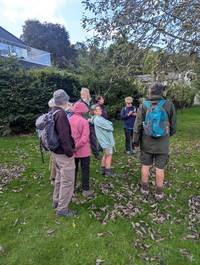
Rather than give a report on the event (see photo), I thought it would be more useful and interesting to describe the walk so you could do it yourself, if so inclined.
I am not a resident of Arnside and there must be many people who know these paths much better than me. To take in all the species, I found it necessary to retrace steps and zigzag. I would welcome suggestions of improvements or other species that could be added.
For the purposes of this walk, I am not distinguishing trees from shrubs. Quite a few plants will grow as a tree or a shrub depending on conditions. Most of the ones listed show a strong affinity for limy soils in the wild, hence the choice of route, although in the garden they will usually grow quite happily in neutral to acid soil.
Start at the south end of Arnside promenade. There is car parking here if you arrive early enough, or it’s a ten-minute walk from the station. The road is a cul-de-sac for cars but pedestrians can continue on a path above the beach. Go this way past the coastguard station until you reach some low cliffs.
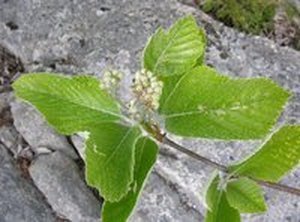
1. Lancashire Whitebeam (Sorbus lancastriensis). This is our local tree, in the sense that all but a handful of individuals are to be found around Morecambe Bay. This is one of a group of related trees that have started producing seed without bothering with pollination and fertilisation. Thus if a tree has what it takes it can be the ancestor of a substantial population of genetically-identical trees which can be treated by botanists as a species.
Further along the cliffs can be found many
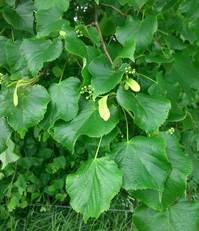
2. Small-leaved Lime (Tilia cordata). This is something of an anomaly on this walk as it grows to the size of a forest tree, unlike the others mentioned. It can, however, be classed as unusual. It was not always so. During the warm spell 6-7 thousand years ago it spread across much of England, as far north as the Lake District, and was very common in its range. Since then, however, it has not set seed and only propagated itself by suckers. Thus, anywhere limes grow has had them in the vicinity for thousands of years, or else they have been planted. The former must apply here for how do you plant a tree on a cliff?
Continue along the top of the beach and watch for a flight of steps leading to a path with a wall on the right. This leads to a small orchard, but the only trees we are interested in here are

3. Orange whitebeam (Sorbus croceocarpa). This tree is something of a mystery - it apparently arose in the 1880s as a hybrid of a whitebeam and a wild service-tree, but nobody knows where. Having inherited the ablility to produce seed asexually, copies could be distributed to many gardens from which a few escaped. It was only described as a species in 1987 and few years later some were found in this area. In the wake of this, two trees were planted here.
Continue through the orchard and turn left up the steep path. Around two bends can be found
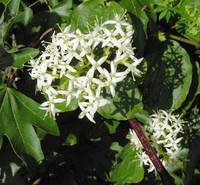
4. Common dogwood (Cornus sanguinea). Dogwoods are much grown in gardens for the colourful stems in winter and it may be suspected that this is an escape, given its location. Close examination indicates that this one is of native stock, however, so I am happy to call it wild.
Retrace steps downhill to the beach. Continue past the yacht club and then look for a gate into a field. Continue to the other end of the field and through another gate. Turn left uphill alongside a wall. When the slope eases but before you reach the top, watch out for a path on the right. This is an "unofficial" path, not marked on the map, but it is clear enough. In about 200 yards there is a collection of saplings of
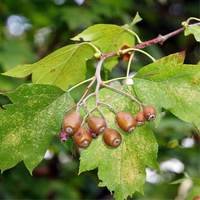
5. Wild service-tree (Sorbus torminalis) The English name is a mystery - why should it be forever subordinate to (and confused with) a completely different (although related) tree? There's no confusion locally, however as there are no true service-trees (Sorbus domestica) in north-west England as far as I am aware. This is the one Sorbus that tolerates shade and is therefore found in woods. I could not find a full-sized tree in this wood although I expect there is one.
Retrace steps back to the path by the wall, continue up the steps to the top path. Turn right along this. As the path curves left downhill, you can find
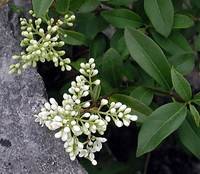
6. Wild privet (Ligustrum vulgare). This loses some (not all) of its leaves in the winter, unlike its Japanese cousin (Ligustrum ovalifolium) which is why the latter is preferred for hedging.
Continue down the hill and through a gate into a scrubby field. Take the first path sharp left heading back into the bottom of the wood but before you reach the gate there is a
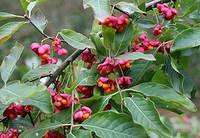
7. Spindle-tree (Euonymus europaeus)
Reverse direction yet again but keep left through another gate, briefly rejoining the coastal path before coming to a road. Turn left and round two bends to come to a clearly marked public footpath. Use this and ascend through the wood. Take the second left and this path should eventually lead through a gate onot a more open field. Shortly you will come across two specimens of
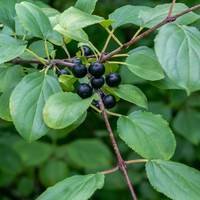
8. Common buckthorn (Rhamnus catharticus). This is the one tree on this walk that seems to actively dislike acid soils.
You can head up the slope anywhere you like here, but it's probably best to wait for a clear path. Well before the top of the field is a gate onto the road. Head downhill on the road and in due course you will find

9. Guelder rose (Viburnum lantana).
This is the last native tree on this walk and you may continue it any way you like, but my preferred route is as follows. Continue downhill until you come to a gate on the right with a notice inviting you into Dobshall Wood. Go through the gate, keeping left at the path junction and down a rough slope to another gate. Going through this, you immediately join a footpath between high hedges. This ends at a road junction, but keep going in the same direction. As you come to Silverdale Road, turn left. Where this path bends right to become an ordinary pavement is a gate, this time with a sign for Ashmeadow Wood. The paths in this wood are a bit of a maze, but keep downhill and you will come back to the start.
The wood has two non-native shrubs that are currently spreading across the country so are worth knowing: snowberry (Symphoricarpos rivularis) and Himalauyan honeysuckle (Leycesteria formosa)
On the actual walk, I explained how to identify the trees we encountered, but have not done so here. I recommend you consult your favourite wildflower guide (tree books usually contain too many trees only found in parks and gardens which confuses things). Your book is unlikely to cover all the various whitebeams, so I give a key (copied from Whitebeams, Rowans and Service Trees of Britain and Ireland by TCG Rich et al. (2026)).
Key to species of Sorbus in Cumbria and Lancashire (v.cc. 60, 69, 70)
- Leaves regularly pinnate S. aucuparia
- Leaves simple to deeply lobed 2
- Leaves unlobed, white-tomentose underneath 3
- Leaves shallowly to deeply lobed, greyish-white-tomentose to green and glabrous underneath 5
- Largest ripe fruits mostly longer than wide; leaves uniserrate to biserrate, veins 18–28 S. aria
- Largest ripe fruits mostly wider than long; leaves uniserrate, veins 12–22 4
- Leaves obovate, veins 15–22, margins with spreading teeth S. lancastriensis
- Leaves obovate-elliptic, veins 12–19, margins with broad teeth curving towards apex S. rupicola
- Leaves glabrescent to glabrous underneath S. torminalis
- Leaves green to greyish-tomentose underneath 6
- Leaves with rounded, elliptic lobes; ripe fruits orangey-red S. intermedia
- Leaves with acute, triangular lobes; ripe fruits yellow, orange, orange-red or brown 7
- Leaves lobed 15–30% of way to midrib, veins 14–21, base mostly truncate to broadly rounded S. latifolia
- Leaves lobed 5–10% of way to midrib, veins 17–24, base broadly rounded to cuneate S. croceocarpa
I didn't include rowan in the walk because it doesn't count as unusual. The other missing ones I couldn't find in the area of the walk. I should perhaps add that some authors split Sorbus into several small genera.